The News About Clark : On Treatment, Empty Seats, and Self-Preservation
The therapist’s office sits off Harry Hines Boulevard, a road synonymous among Dallasites with prostitution, crime, and general debauchery. Indeed, the office is sandwiched between a cabaret and a strip club. The therapist once admitted it was an odd location for an institution concerned with healing men’s sexual afflictions, like building a Betty Ford clinic beside a Sigel’s. But because most of his clients are prohibited from being within a certain distance of schools and parks, there are few places in the city where a roomful of registered sex offenders can legally gather.
Like the neighborhood, the building itself feels vaguely disreputable. The dark, narrow hallways are lined with doors stenciled with obscure acronyms and business names suggestive of legal disputes, failing relationships, and brokenness. Lockout notices are taped to several windows. Up on the fifth floor, behind a door marked AIM Counseling, men gather each week to discuss sex, shame, and the crimes that brought them there.
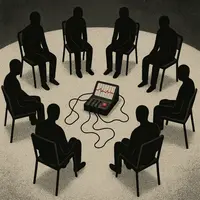
Whether by human nature or the ingrained sense of territory and routine particular to former inmates, group participants gravitate toward the same seats week after week. As the group settles in, I look around the circle and see faces, some familiar, some relatively new.
Beside me sits Robles, the newest and youngest member of the circle. At nineteen years old, Robles was referred to sex offender treatment as part of deferred adjudication for a crime he committed when he was sixteen: posting nude pictures of his then high school girlfriend online.
Across from Robles sits Glenn, another newcomer, who was accused of attempted rape by his wife, a charge he denied on his first day in group. He told us she called the cops out of anger and vengeance, having just learned about Glenn’s recent infidelity.
The accusation was absurd, Glenn had said. He was no sex offender. He didn’t belong in therapy. We were willing to believe in his innocence until Glenn remarked offhandedly that, besides, it was impossible for a husband to rape his wife. The therapist pounced and, for the better part of an hour, admonished Glenn for his views on marriage and consent. Glenn had tried to hold his ground. A religious man, he cited passages from Ephesians and Corinthians as proof that wives are to submit to their husbands and have no authority over their own bodies. The therapist, himself a Christian, countered that Ephesians likewise commands husbands to love their wives as Christ loved the church and to remain faithful to them. “You cannot,” he said, “quote the Bible only when it benefits you.” Glenn had nothing more to say.
Nor did Donald, the oldest and longest-tenured member of the group, who sat opposite Glenn, have much to say. While the rest of the group had seemed more than willing to side with the therapist and explain exactly where Glenn was wrong, Donald sat with his arms folded across his chest, staring at a spot in the carpet at the center of the circle. It was a posture he’d adopted often of late. With only two months remaining on probation for possession of CP, and with his time in the group therefore drawing to an inevitable close, he no longer felt any obligation to take up the whip. It was also possible he was still smarting from his own dressing-down a month earlier.
There is a glorious feeling of levity, almost of absolution, that comes with arriving at group bearing news of a passed polygraph. For a brief moment, one is not the offender under suspicion but the man who has been vindicated. This had certainly been true of Donald. He arrived that day looking visibly lighter, behaving with an uncharacteristic jocularity, grinning and cracking jokes.
“I passed,” he announced proudly to the therapist and others.
“Sure,” the therapist said, “but only after you disclosed to the polygrapher that you grabbed your coworker’s ass in the stockroom at work.” Public lewdness, the therapist reminded him, was a misdemeanor.
Donald’s smile crumbled, replaced by wounded bewilderment. “But she grabbed my crotch first!”
The therapist explained that men in our situation—registered sex offenders—live under greater scrutiny and must take extra precautions in matters of sex. What might seem like harmless flirtation can carry serious consequences, especially considering that the coworker was, as we knew from prior group discussions, a married woman. What if another employee had walked in and reported the encounter to management, or to the woman’s husband? What if the husband became angry and his wife, in an effort to save face, claimed the flirtation had not been consensual? What if she accused Donald of assault? Given Donald’s history, the therapist argued, the authorities would be inclined to believe her, and the penalties for a second sex offense would be severe.
Donald knew the therapist was right, of course. It was a fear all of us shared. The therapist understood how tenuous our freedom was, and he seemed to regard it as part of his duty to keep that fear alive.
The therapist emerges now from his office carrying the usual clipboards and roll-call sheets and settles into his seat beside Donald at the head of the circle, stretching his long, lanky legs toward the center. Occasional confrontations aside, the therapist was really a rather mild and affable man who seemed under no pressure to finger-point. Instead he preferred to while away the first half hour of group talking about cars, motorcycles, and the renovations he and his wife have been making to their home in the country. He was aware of how his relaxed manner in the group might strike some as unbefitting of a therapist tasked with the urgent work of rehabilitating men society deemed sexual deviants. But he once countered this potential criticism by telling us that, had he believed any of us to be truly dangerous, he’d have us crack open our textbooks the moment we sat down. Robles had raised his hand and asked the therapist if he had any clients he believed were truly dangerous.
“A few,” he said. “It seems it’s the guys who claim to be the most devout who are the most delusional.”
My eyes immediately fell on Glenn.
The therapist shuffles through his roll-call sheets and then, as though remembering something, looks up from his papers.
“I have some unfortunate news about Clark.”
Clark.
Only then do I notice the empty seat beside Donald.
Like all of us in the group, Clark was required to take regular polygraphs to confirm compliance with the terms of his probation, specifically the rule that forbade us from viewing pornography. Clark had failed his last two polygraphs and was on the verge of getting kicked out of treatment if he didn’t pass the retake. A third failure would also likely mean he’d be sent back to prison, as had happened to me years earlier.
A sandy-haired, sleepy-eyed man in his late twenties, Clark swore to the therapist and the group that he hadn’t looked at pornography. He suspected it was the stress and high stakes of the examination that had caused him to fail, which was as plausible an explanation as any. After the second failed polygraph, the therapist urged Clark to take a hard look at his conscience. Perhaps he hadn’t viewed pornography exactly, but was there not something else troubling him? Perhaps he’d lingered outside a sex shop and peeked through the window. Maybe he’d seen a brief flash of nudity in a movie and hit rewind.
“Just admit to something,” the therapist had said, for he believed that the polygrapher would be more inclined to pass Clark if he could offer up some small concession. But Clark refused to budge. He insisted his conscience was clear and that he could think of nothing he’d done wrong.
Clark’s stubbornness had irritated me. Whether he had looked at porn was beside the point. There was an unspoken understanding in the group that everyone was expected to surrender something—a lapse, a temptation, a private failing, however small. But Clark, whether out of naïveté or stubbornness, refused to play the game. And now it seems his refusal to budge had cost him. He had failed yet another polygraph and been booted from the group.
“I received some news,” the therapist says. “Clark has passed away.”
The self-satisfied smirk that has been teasing the corner of my mouth vanishes.
“We believe he took his life.”
The therapist tells us that Clark’s body was discovered in his car somewhere along the Texas-Oklahoma border. He’d just come from visiting his parents in Tulsa. There’d been a hose connected to the car’s tailpipe.
I am reminded of a conversation we’d had in group years ago when I’d failed my polygraph and was facing the prospect of returning to prison. The therapist had asked whether I’d had any thoughts of self-harm, to which I’d answered truthfully: yes, if only in an academic sense. Clark had turned in his chair, fixed his sleepy gaze on me and said, “That would be a shame if you did. You seem like someone I would’ve enjoyed having a beer with.”
His seat, now empty, seems like an affront.
Glenn, his hand resting on the Bible he always brought with him to group, is the first to speak. He speculates that Clark must not have had a strong “spiritual grounding” to keep him afloat.
The therapist offers his own assessment. He says Clark lacked motivation. “All he wanted to do was smoke weed and play video games.” Which is true but sounds callous now that Clark is dead. He goes on to say he suspects that Clark had been lying about looking at pornography, that the lies had caught up with him. He saw the writing on the wall and decided he’d rather not face the consequences.
The other men in the group chime in as well, each seemingly eager to offer his own explanation for Clark’s fate. I find this strange coming from men who know firsthand the burden of being judged. It seems to me they are trying to put distance between themselves and Clark—not only to spare themselves suspicion, but to avoid confronting how easily they might have found themselves in his place.